
Small Grant, Big Proof: How Fund for the Arts Mini-Grants Build Your Reporting Muscle (Deadline Oct 16)

In today’s competitive market, your arts or community nonprofit must show more than a compelling event idea: you must show measurable community value. You often have limited staff, scattered attendance information, and little time to turn program activity into credible funder evidence. This is where a small grant becomes invaluable: you can use one focused project to build the reporting habits that support larger awards later.
1. Start with a Timely Opportunity
The Fund for the Arts Community Event Mini-Grant offers $500 to $5,000 for short-term, free, arts-related gatherings in the Greater Louisville area. You may use the opportunity to support a performance, exhibit, culinary arts experience, creative workshop, or another in-person event that brings people together.
You are eligible if you are an individual artist, community group, business, or nonprofit organization based in Bullitt, Jefferson, Oldham, or Shelby counties in Kentucky, or Clark, Floyd, or Harrison counties in Southern Indiana. Your event must be free, open to the public, arts-focused, and connected to a specific neighborhood, shared interest, or cultural community.
Your application deadline is October 16, 2026. You must apply through the Fund for the Arts online grant portal. You can also review the updated Mini-Grant Guidelines before preparing your responses.
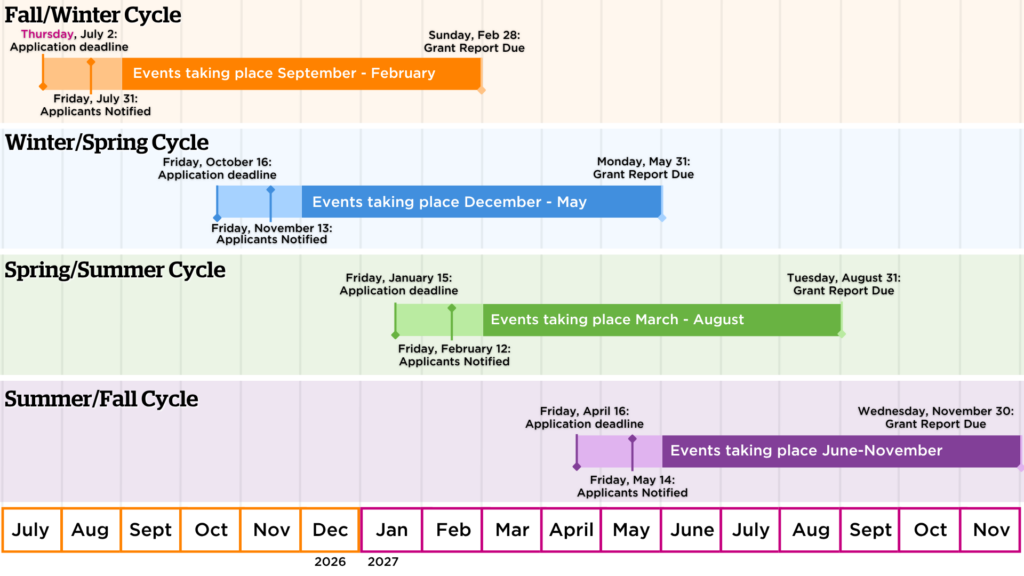
The opportunity is small by traditional grant standards, but the reporting expectations are practical and specific. You will need to think about attendance, demographics, neighborhood impact, paid artists, stories, photos, videos, and the communities your event reaches.
2. Treat the Grant as Practice
The most valuable mindset shift is simple: treat this mini-grant as reporting practice, not just quick cash.
Your event may have a modest budget, but the habits you establish can carry into larger arts, culture, and community foundation applications. You can define your outcomes before the event, assign responsibility for data collection, and create a short reporting closeout immediately afterward.
[Image: Nonprofit team planning attendance, reach, and survey KPIs]
A 2024 study from Adelphi University’s Nonprofit Leadership Impact Study found that only 20% of nonprofit leaders considered their organizations very effective at demonstrating outcomes. That gap creates an opportunity for you. A small event gives you a manageable setting to improve your measurement process before a larger award makes the consequences of weak data more expensive.
For example, you can use the mini-grant to test one standard event dashboard. After the event, you can review what worked, correct your definitions, and save the process as a repeatable template.
3. Track More Than Attendance
Attendance is important, but attendance alone rarely explains community impact. You can build a stronger evidence base by tracking a small set of connected measures.
For your community arts event, track:
Planned versus actual attendance: Record your expected turnout and compare it with registrations, check-ins, or a carefully documented headcount.
Geographic reach: Capture ZIP codes, neighborhoods, council districts, or other location information when appropriate and consent-based.
Demographic reach: Track age and race information using a voluntary, clearly explained process that protects participant privacy.
First-time attendance: Ask whether participants are attending your event for the first time.
Partner participation: Record the artists, arts organizations, neighborhood groups, businesses, and community partners involved.
Survey or feedback response: Ask what participants valued, what they learned, and whether they would attend another event.
Neighborhood engagement: Document new partnerships, volunteer involvement, community recommendations, and follow-up activities that result from the event.
The Fund for the Arts reporting guidance specifically asks grantees to report attendance with age and race information, the number of artists or arts organizations paid through the award, the primary neighborhoods and council districts affected, and one to three stories of impact with one to three photos or videos.
That structure gives you a useful output-to-outcome framework. Attendance is an output. A participant reporting greater connection to the neighborhood is a short-term outcome. A new collaboration that continues beyond the event may indicate deeper community impact.
For instance, a free neighborhood mural workshop may serve 85 people, including 40 first-time attendees. A follow-up survey may show that 78% felt more connected to local artists, while two neighborhood partners agree to co-host another program. Those figures and stories work together.
4. Use the Match to Improve Data Discipline
The match requirement is not only a budget issue. It is also an opportunity to strengthen how you document resources.
Requests up to $2,000 do not require a match. Requests above $2,000 require a 1:1 match on the amount above $2,000, using cash, in-kind contributions, or a combination of both. A $2,500 request requires a $500 match. A $5,000 request requires a $3,000 match.

You should document every match source before submitting your application. For cash, identify the committed or anticipated funding source. For in-kind support, record the donor, item or service, quantity, estimated value, and confirmation method.
For example, if a venue donates space normally rented for $1,200 and an artist provides $800 in donated services, you have documented $2,000 in in-kind support. Your records should show how each amount was calculated and who confirmed the contribution.
This process matters because larger funders will ask similar questions about leverage, community investment, and the full cost of delivering your work. A clean match schedule teaches you to connect budget assumptions with supporting documentation instead of relying on estimates you cannot explain later.
5. Build a KPI Library for Larger Grants
Your mini-grant data can become the first version of a reusable KPI library. You can define each measure once and then adapt it across programs, grant applications, board reports, and annual reports.
Start with three core KPI categories:
Reach: Who participated, where participants came from, and how many people engaged.
Participation: How many people attended, whether participants were first-time or returning, and how partners contributed.
Satisfaction and learning: What participants valued, what changed for them, and whether they want continued engagement.

A KPI definition should include the metric name, purpose, data source, collection timing, calculation method, and responsible staff member. For example, “attendance” should specify whether you count unique people, total visits, registrations, or estimated headcount.
This level of consistency becomes increasingly important as your organization grows. A 2024 study from Adelphi University found that 72% of nonprofits use an impact or annual report to support fundraising, while approximately 40% reported lacking the resources to compile impact data. Your advantage comes from building the system before you need to produce a large report under pressure.
You can also separate your reporting products by audience. Your board may need a one-page scorecard showing reach, cost, satisfaction, and next steps. A funder may need attendance by demographic group, artist payments, neighborhood impact, and a participant story. Your public audience may need a short narrative with accessible visuals.
The underlying KPI library can remain the same while the presentation changes.
6. Turn Small Data Into a Reporting Engine
You do not need an expensive technology platform to begin. You need a clear measurement plan, consistent definitions, simple collection tools, and a monthly or project-based review process.
Before your event, create a one-page measurement plan. Assign one person to attendance, one person to partner and match documentation, and one person to surveys or participant feedback. During the event, use the same check-in process for every participant. Within one week, reconcile the numbers, review missing information, save photos and stories, and record what you would change next time.
You can then store the results in a shared workbook or dashboard. Over time, each event adds another data point to your evidence base. You may begin to see patterns in neighborhood reach, attendance, satisfaction, partner performance, and cost per participant.
Genesis Strategic Consulting’s Board + Funder Reporting System helps you turn that information into a repeatable structure, including a KPI dictionary, data workbook, board scorecard, funder reporting format, and dashboard prototype or build. The service is designed for grant-funded nonprofits that need practical reporting systems without hiring a full-time analyst.
According to Genesis, clients using its reporting support commonly save one to two staff days per month through cleaner reporting workflows and recurring data checks. That time can give you more capacity for program delivery, funder relationships, and strategic planning.
Final Thoughts
A Fund for the Arts mini-grant can help you fund a meaningful neighborhood gathering while building stronger habits around reach, participation, demographics, satisfaction, partnerships, and community impact. The October 16, 2026 deadline gives you a clear reason to organize your data practices now.
If you are preparing a Community Event Mini-Grant application or reviewing the results of a recent arts program, schedule a Genesis Reporting Diagnostic. You can turn one small grant into the foundation for a cleaner, more credible, and more repeatable funder-ready reporting engine.
Comments