
From Passion to Profit: How to Write a Business Plan That Actually Gets Funded
- Anthyun Mask

- Feb 9
- 5 min read
Updated: Feb 12
You've got the dream. The late-night brainstorms, the vision board, the unshakable belief that your idea can change the game. But when you walk into a bank or pitch to an investor, passion alone won't open their wallet. In today's competitive funding landscape, you need a business plan that transforms your vision into a compelling, data-backed investment opportunity. This is where a professional, strategically crafted business plan becomes your most powerful tool.
Why Your Business Plan Is Your Funding Gateway
A business plan is not just a formality: it's your proof of concept. Lenders and investors see hundreds of pitches, and they can spot an unprepared founder within minutes. Your business plan demonstrates that you've done the hard work: researched the market, understood your competition, and mapped out a realistic path to profitability.
According to the Small Business Administration, businesses with formal plans are twice as likely to secure funding compared to those without. This document is your narrative, your financial roadmap, and your credibility rolled into one. When done right, it positions you as a serious entrepreneur worthy of investment.

Start With Crystal-Clear Purpose and Precision
The first mistake many founders make is being vague about why they need funding. "We need money to grow" doesn't cut it. Investors want specificity. Instead, frame your funding request around a concrete problem you're solving or opportunity you're capturing.
For example: "We need $75,000 to launch our e-commerce platform and capture the growing demand for sustainable home goods in the Southeast region." This statement tells the funder exactly what the money will do and why now is the right time. When you articulate a precise, well-researched funding amount: broken down by equipment costs, marketing expenses, inventory, and working capital: you demonstrate financial literacy and planning competence.
Avoid inflated or arbitrary numbers. Research shows that investors can detect padding immediately, and it erodes trust faster than anything else. Calculate your actual expenses down to the dollar, then present them with confidence.
The Missing Piece: SWOT Analysis
Here's where many business plans fall apart: the absence of a thorough SWOT analysis. Founders get so excited about their product or service that they skip the critical step of showing lenders they actually understand the market landscape they're entering.
A SWOT analysis: Strengths, Weaknesses, Opportunities, and Threats: is the backbone of a realistic, fundable business plan. It transforms a "dream pitch" into a "strategy document" that banks and investors can trust. When you lay out your internal strengths (experienced team, proprietary technology, strong supplier relationships) alongside your honest weaknesses (limited brand recognition, cash flow constraints, small team), you build credibility.
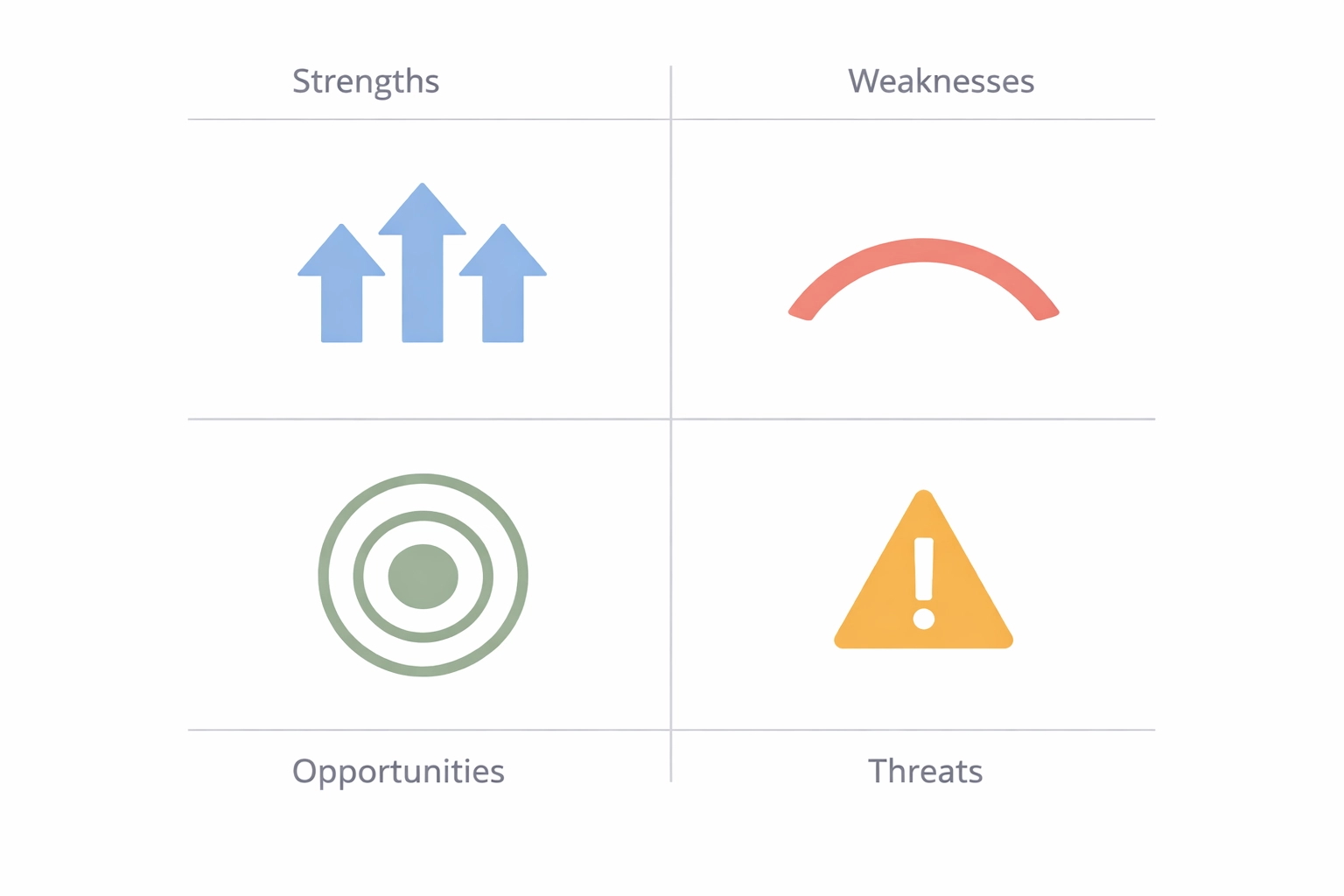
More importantly, the Opportunities and Threats sections prove you've done your homework. Identifying emerging market trends, gaps in competitor offerings, or shifting consumer behaviors shows forward-thinking leadership. Acknowledging threats: new regulations, economic downturns, competitive pressures: demonstrates maturity and preparedness.
For instance, if you're launching a food delivery service, your SWOT might reveal:
Strength: Partnerships with 50 local restaurants
Weakness: Limited delivery radius in Year 1
Opportunity: 25% annual growth in food delivery demand in your metro area
Threat: Established competitors with deeper pockets
This level of analysis tells funders: "This founder knows what they're up against and has a plan to win."
Ground Every Dollar in Growth Outcomes
Don't just list expenses: connect them to results. Investors don't fund line items; they fund growth potential. When you request $40,000 for production equipment, follow it immediately with the outcome: "This machinery will increase our production capacity by 50%, enabling us to fulfill 300 additional orders monthly and generate an extra $180,000 in annual revenue."
This narrative shift moves your plan from transactional to transformational. You're not asking for money: you're offering an investment opportunity with clear ROI. Break down your funding request into specific categories, then tie each one to measurable business milestones: customer acquisition, market expansion, operational efficiency, or revenue growth.
For example:
$30,000 for digital marketing → Acquire 500 new customers in Q1
$25,000 for inventory → Meet seasonal demand without stockouts
$20,000 for hiring → Add two sales representatives to double outreach capacity
Each dollar becomes a strategic lever for accelerating your path to profitability.

Financial Projections That Inspire Confidence
Your business plan must include realistic, data-backed financial projections. This means five-year revenue forecasts, cash flow statements, break-even analysis, and profit margins. Research from the Harvard Business Review indicates that investors spend more time analyzing financials than any other section of a business plan.
Be prepared to explain your customer acquisition costs, lifetime value calculations, and monthly burn rate. If you're projecting $500,000 in Year 1 revenue, show the math: number of customers × average transaction value × purchase frequency. Ground these numbers in market research, industry benchmarks, or pilot program results.
Don't oversell. Conservative projections with solid reasoning beat aggressive forecasts with weak foundations. Investors appreciate founders who understand that business rarely goes exactly according to plan. Build in reasonable assumptions and explain your contingencies.
Tailor Your Plan to Your Funding Source
Not all funders are created equal, and your business plan should reflect that. Banks prioritize stability and repayment capacity: they want to see steady cash flow and collateral. Investors, on the other hand, are hunting for high-growth potential and scalable business models.
If you're approaching a bank, emphasize your debt service coverage ratio, personal credit score, and established revenue streams. If you're pitching to angel investors or VCs, lean into your market disruption potential, competitive moats, and exit strategy. Grants and crowdfunding campaigns require alignment with specific missions or social impact outcomes.
A study from the Institute of Management Consultants found that businesses that customize their approach by funder type see approval rates 40% higher than those using a one-size-fits-all strategy. Take the time to research what your target funder values most, then structure your narrative accordingly.
Show Them the Money (and How They'll Get It Back)
Every investor or lender has one fundamental question: "How do I get my money back: and when?" Your business plan must clearly articulate your repayment or exit strategy. Will investors receive equity stakes, quarterly dividends, or an eventual buyout? How quickly can they expect returns?
For debt financing, present a detailed repayment schedule showing monthly payments over the loan term. For equity investments, outline potential exit scenarios: acquisition by a larger company, merger, or IPO (if applicable). Be realistic about timelines: most investors expect 3-7 years before seeing significant returns in early-stage ventures.
This section transforms your ask from a favor into a compelling investment opportunity. You're not seeking charity; you're offering a strategic partnership with clear financial upside.
How Genesis Consulting Makes You Bank-Ready
Writing a fundable business plan requires expertise in financial modeling, market analysis, competitive positioning, and storytelling. That's where Genesis Consulting comes in. We specialize in helping entrepreneurs, pre-seed startups, and small business owners translate their vision into professional, investor-ready business plans.
Our team works with you to conduct comprehensive SWOT analyses, build realistic financial projections, and craft compelling narratives that resonate with your target funders. We know what banks want to see, what investors question, and what turns a "maybe" into a "yes."
From refining your funding request to stress-testing your financial assumptions, we ensure your business plan is buttoned-up, credible, and designed to win capital. If you're ready to move from passion project to funded enterprise, Genesis Consulting can help you get there.
Final Thoughts
Turning your passion into profit requires more than enthusiasm: it demands a strategic, well-researched business plan that proves you're ready for investment. By starting with a clear purpose, including a thorough SWOT analysis, grounding your funding request in measurable outcomes, and tailoring your approach to your specific funder, you dramatically increase your odds of securing the capital you need.
The entrepreneurs who succeed aren't always the ones with the best ideas: they're the ones who can articulate their vision with precision, back it up with data, and demonstrate they understand both the opportunities and risks ahead. If you're ready to transform your business dream into a funded reality, now is the time to invest in a business plan that opens doors.


Comments